Featured / Between Sessions
The Most Boring Tool in Music Might Be the Most Important
A defense of the metronome: the dull little click that exposes sloppy timing, cuts through gear excuses, and reminds musicians how growth actually happens.
June 16, 2026 / 7 minute read
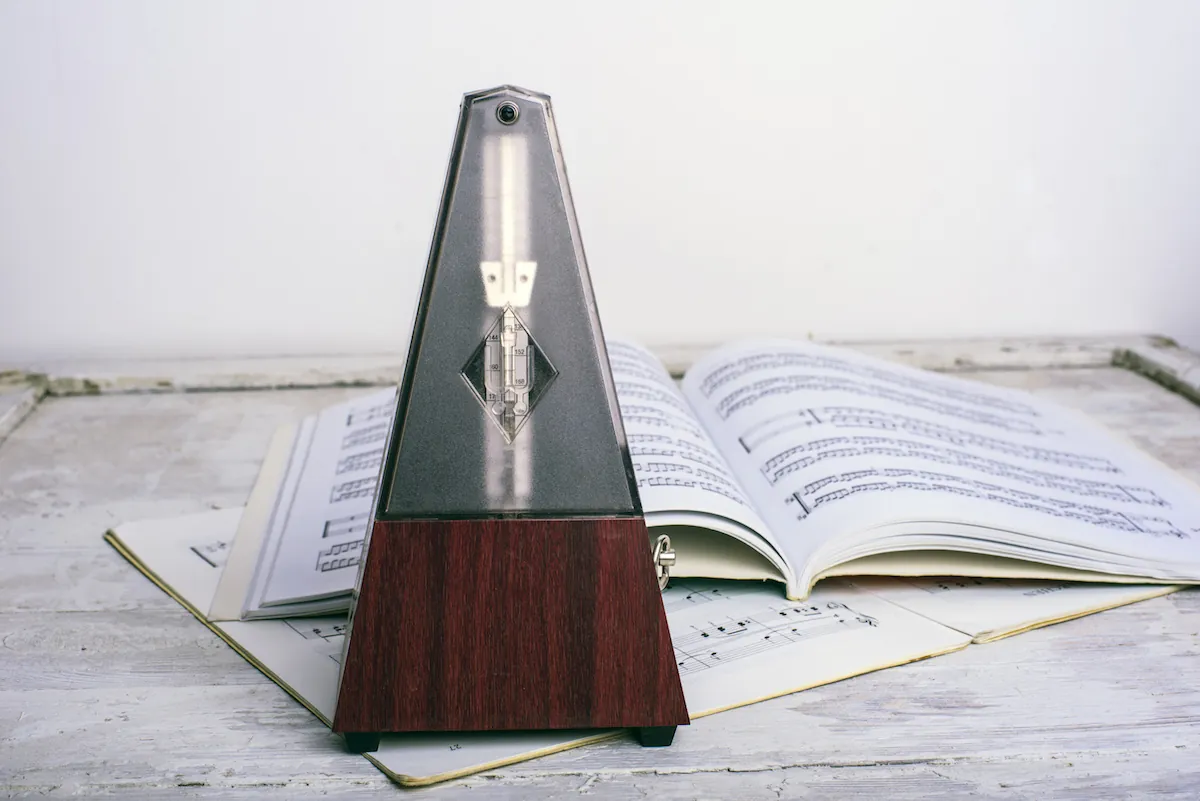
I wanted to challenge myself with the launch of SOFT STATIC by writing about something I considered painfully boring. There are a million things I'd rather talk about than a metronome. I'd rather write about a favorite album, a guitar tone I can't replicate, or some obscure indie artist with 8,000 monthly listeners that I've become obsessed with for two weeks. Instead, we're talking about a little box that clicks.
I finally bought a physical metronome this year. It sits on the edge of my desk next to an old Casio keyboard. Truthfully, I bought it because I thought it looked cool. There's something oddly charming about a piece of technology that's barely changed in over two hundred years. Most music gear gets replaced every few years by something newer and more complicated. The metronome just sits there doing the exact same thing it's always done. I guess that's why it works.
For anyone unfamiliar, the metronome is designed to keep a steady tempo. The modern version dates back to the early 1800s and became a way for composers to communicate exactly how fast they wanted a piece performed. Nowadays, most musicians don't need a physical one. Google has one. GarageBand has one. Every DAW imaginable has one. The funny thing is that despite having access to them for years, I mostly ignored them.
Like a lot of self-taught musicians, I figured I had decent timing already. I could play songs all the way through. I could record demos. I could jam with friends. I wasn't exactly getting thrown out of rehearsal spaces for rushing songs. But, there came a day when my guitar teacher made me start practicing scales with a metronome.
At the time, I thought it was a complete waste of time. I remember sitting there running minor pentatonic patterns while listening to that relentless clicking. It felt less like making music and more like doing math homework. But after a few weeks, I started noticing I wasn't nearly as consistent as I thought I was.
That's one of the weird things about music. There are mistakes you can hear immediately, and there are mistakes that hide from you. If I hit a wrong note, I know it. If I forget a chord change, I know it. Timing isn't always like that.
You can feel completely locked in while you're playing and then listen back later only to realize you've been speeding up every difficult section and slowing down every easy one. The human brain is surprisingly good at convincing itself that everything is fine. The metronome doesn't really allow that.
A click track is honest with you. You're either on time or you're not. I think that's why so many people avoid practicing with one. It's frustrating. Nobody enjoys discovering that the thing they've been doing for years isn't quite as polished as they thought it was. But that frustration is usually where improvement starts.
When I was sixteen, my dad and I split the cost of a cheap drum kit for my birthday. I was thrilled. I had wanted one for a long time, and for the next few months I basically lived behind it. But I ran into a problem almost immediately. Whenever I was playing something and I thought it sounded great, the next logical option was typically to record my work. But listening back was always a painful experience. The fills felt uneven and some sections rushed ahead. I'd finish a take feeling like I had absolutely nailed it and then wonder who the guy on the recording was.
Instinctively, I didn't really think it was a time issue. Maybe my technique wasn't good enough. Maybe the drums weren't tuned properly (I guarantee they never have been). Or maybe I just needed more practice. All of those things were partially true, but eventually I realized that every time I practiced, I was burying myself in backing tracks and reference songs. There was always so much happening that it became difficult to hear what I was actually contributing.
So with time, I started to strip everything away. No backing tracks, which certainly takes away from the rush, I must admit. But back to basics, just me and a click. It was unbelievably boring. It was also one of the most productive things I've ever done.
Looking back, I think the biggest lesson the metronome taught me wasn't even about rhythm. It was about simplicity. Musicians love making things more complicated than they need to be. I'm guilty of it constantly, I'll spend twenty minutes searching for the perfect guitar tone before admitting I haven't actually practiced the part yet. I'll convince myself that a new plugin is the missing ingredient when the real issue is that my performance isn't tight enough.
The metronome cuts through a lot of that. You can't blame timing issues on your equipment. You can't blame them on your mix. You can't blame them on your DAW. It's just you. For that reason alone, I think every musician should spend at least some time practicing with one.
Not all the time, obviously. Music should still be fun. Some of my favorite moments playing guitar have come from throwing on a backing track and completely losing track of time. There is absolutely a place for that. But I think a lot of musicians fall into the trap of only practicing the fun stuff.
It's the same reason people learn the intro to ten songs instead of the entirety of one. The fun part is immediate. The growth part usually isn't. I hate to admit; I'm still one of those people despite being self-aware of it.
But one thing I've started doing over the past year is slowing everything down far more than feels necessary. If there's a riff I can comfortably play at full speed, I'll often cut the tempo in half and play it there. It's amazing how quickly flaws start showing up. Suddenly, little inconsistencies become obvious. You notice extra movements in your picking hand. Notes that sounded clean before suddenly don't. Things you thought were second nature turn out to need more work.
Then when you gradually raise the tempo again, everything feels easier. It's not a revolutionary concept, but it makes sense. Most worthwhile things in music aren't revolutionary. They're just repetitive.
I think that's part of the reason the metronome has survived for so long. Despite all the advances in music technology, despite the endless supply of software and plugins and AI-powered tools, musicians still need to learn how to keep time. That hasn't changed.
I sit down with musician friends sometimes and realize some of them have never really learned to work with a count-in. They'll start recording before the beat arrives or lose track of where measure one actually begins. It's never something I judge people for, but it does make me realize how accessible music has become, which is mostly a good thing.
But the barrier to entry has never been lower. Someone can download GarageBand today and start making songs tonight. That's incredible, though the downside is that access to tools has become easier than access to fundamentals. You can make music without understanding rhythm. You can make music without understanding theory. You can even make music without knowing how to play an instrument. But eventually, if you stick with it long enough, the fundamentals come calling. Timing is one of those things you can ignore for a while, but it always catches up to you.
The older I get, the more I realize that music is basically just a collection of small improvements stacked on top of each other. Nobody becomes a great guitarist overnight. Nobody records a great album overnight. Nobody builds a following overnight. Everything grows a little at a time.
The metronome is kind of a reminder of that. Every click is another repetition. Another chance to get something right. It's still boring. I still don't particularly enjoy sitting down and practicing scales to a click track. But every time I stop doing it for a few weeks, I notice the difference.
And that's probably the strongest argument I can make for it.